
Stories of the Saints
Saint Bruno
The famous professor who said no to a bishop’s chair and yes to a silent cell in the mountains.
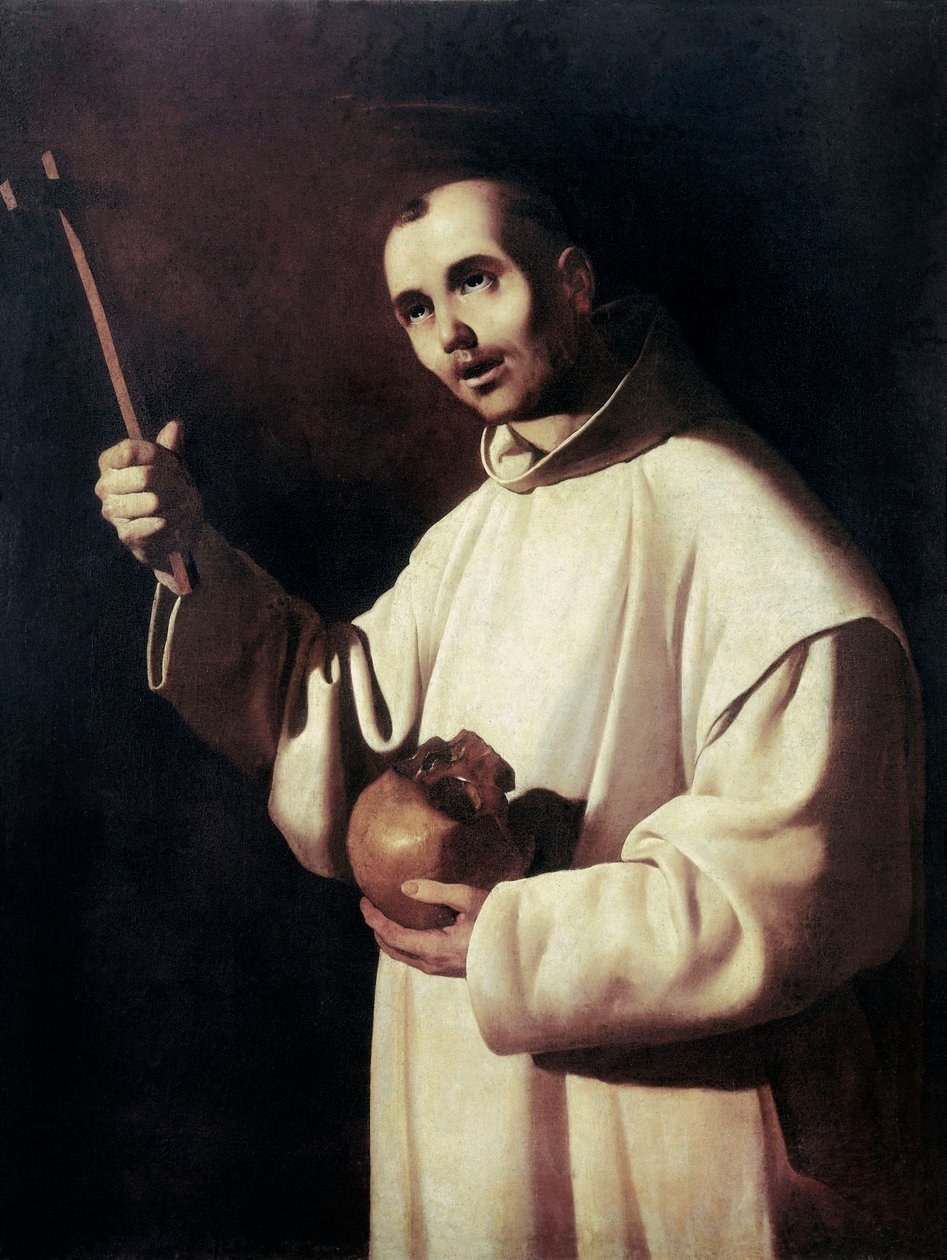
Listen above, or read his story right here — same story, your choice.
The Basics
- Feast day: October 6.
- Lived: about 1030 to October 6, 1101.
- Born: Cologne, in modern-day Germany.
- Known for: founding the Carthusians, the Church's great order of silence and solitude.
- Teacher of: Eudes of Châtillon, who became Pope Urban II.
- Honors: never formally canonized in his own order's lifetime custom of avoiding public honors; his feast was approved by Leo X in 1514 and added to the universal calendar in 1623.
The professor
Bruno was born in Cologne around 1030, into a respected family, and educated at Reims and Tours, two of the best schools in Europe. He was ordained a priest back home, and in 1057 the call came that shaped the first half of his life: Reims wanted him back, this time as head of its cathedral school and overseer of education for the whole diocese.
For close to twenty years Bruno ran that school, and he ran it well. He became chancellor of the diocese, and his lecture rooms were the kind other schools measured themselves by. His students included bishops and abbots — and one young monk named Eudes of Châtillon, who would one day be known to history as Pope Urban II.
Then a new archbishop arrived at Reims, a worldly man whose appointment stank of money and politics, and Bruno — the respected professor, the chancellor — refused to look the other way. He protested the corruption openly. It cost him everything: his offices, his position, and finally his safety. In 1076 he had to flee the city.
The archbishop was eventually deposed, and churchmen wanted Bruno to take the job himself. The king of France blocked it. And Bruno had already begun to understand that he did not want to go back and sit in a chair anyway. He wanted something else entirely, something he could hardly have named yet: quiet.
Seven men and seven stars
Bruno spent a short time at Molesme under Abbot Robert, still searching. Then, in 1084, at about fifty-four years old, he gathered six companions and went south to ask Bishop Hugh of Grenoble for the most remote piece of land he had to give.
The tradition the Carthusians love says that Hugh had dreamed of seven stars falling to earth in a wild mountain valley, and that when seven men arrived asking for a desert, he knew where to send them. He led the little group into the high valley of Chartreuse — steep, forested, snowbound much of the year, and empty of everything but weather.
They built an oratory and a row of small separate cells, one for each man, and began one of the most austere lives the Church has ever produced: each monk mostly alone in his cell, praying the hours, copying manuscripts, working with his hands, eating simply, meeting his brothers mainly for worship and a weekly walk. There was as yet no written rule — only seven men's shared conviction that God was worth being silent for.
That valley gave the order its name: the Carthusians. And their motto, which still circles the cross on their seal, is the shape of Bruno himself: Stat crux dum volvitur orbis — the Cross stands steady while the world turns.
Summoned away from the silence
Six years. That is all the uninterrupted quiet Bruno got at Chartreuse, and he cannot have known it was on loan.
In 1090 a letter arrived from Rome. His old student Eudes was now Pope Urban II, embattled in the great fights of the age — a rival claimant to the papacy, a hostile emperor, a Church badly in need of reform — and he wanted his teacher at his side.
Bruno went. Everything in him resisted it, and he went anyway, out of obedience. He counseled the pope through some of the hardest months of that pontificate. Urban, grateful, offered him the archbishopric of Reggio in Italy — a mitre, a city, a name in the world. Bruno declined it, plainly and finally.
He asked only to go back to being a hermit. Urban would not let him return as far as France, but he let him go as far as Calabria, in the toe of Italy. And there, in the hills around La Torre, with land granted through Count Roger of Sicily, Bruno founded a second hermitage in 1091: Sainte-Marie-de-la-Tour. The monks back at Chartreuse sent their Landuin all that way to ask their founder how they should live; Bruno instructed them, comforted them, and blessed them — and stayed.
How the quiet man finished
Bruno lived out his last decade in the Calabrian hills: sought out for counsel by counts and monks, giving it, and always returning to his cell. As he felt death approaching in 1101, he gathered his monks around him and made a careful public profession of faith — a testimony his brothers preserved word for word, down to his firm belief in the true presence of Christ in the Eucharist. On October 6, 1101, he died among them.
He was never formally canonized by the long modern process. His sons, who shunned all publicity as a matter of principle, did not seek honors for him. But the Church found him anyway: Leo X approved his feast for the order in 1514, and in 1623 his name was placed on the calendar of the whole Church, on the day of his death.
The order he founded is often called the one that never needed reforming because it was never deformed — nine centuries of men and women living in cells, saying the same prayers, keeping the same silence he kept. He left no great collected works, only a commentary on the Psalms, another on the letters of Paul, and a handful of letters. The rest of what he wrote, he wrote with a life.
Saint Bruno, pray for us.