
Saint Faustina Kowalska
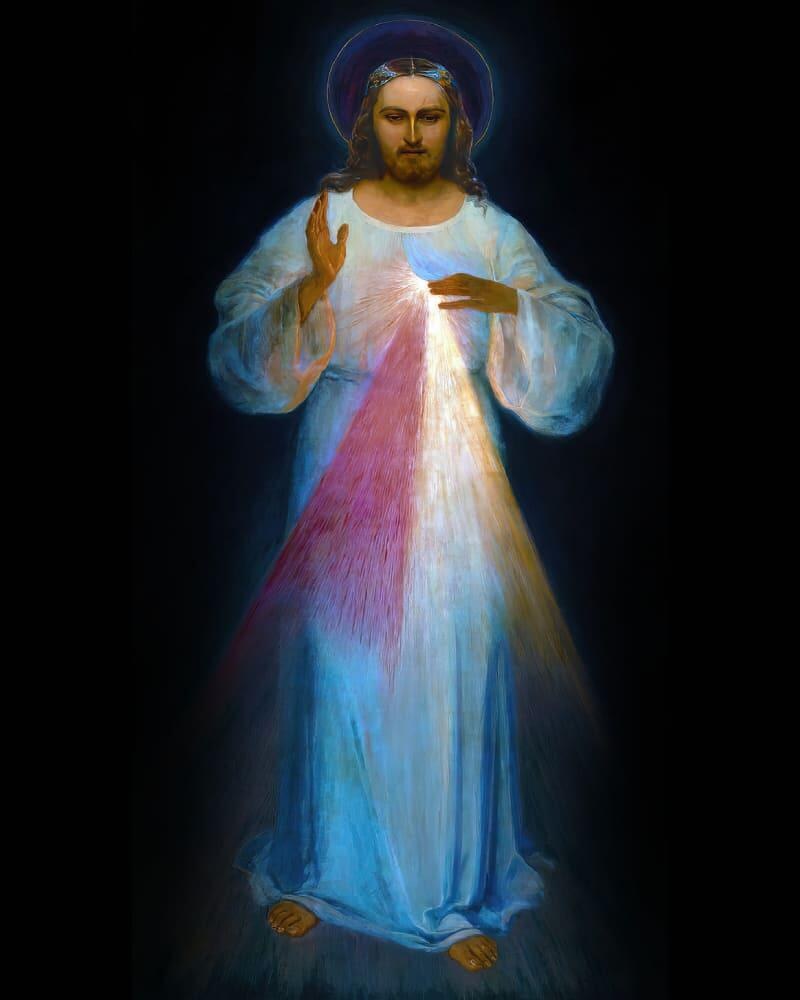
If you have ever prayed the Divine Mercy Chaplet, you have already met this week’s saint. The chaplet came through her. So did the image of Jesus in white, one hand raised in blessing, with two great rays streaming from His heart and the words underneath: Jesus, I trust in You. So did Divine Mercy Sunday, and the three o’clock hour of mercy. Every one of them arrived the same way — through a young Polish sister who worked in a convent kitchen, could barely spell, and died at thirty-three, before almost anyone had heard her name.
Her feast day is October 5. She spent her whole earthly life being overlooked, so being noticed late would not surprise her a bit.
The Basics
Born: August 25, 1905, in Głogowiec, Poland — christened Helena, the third of ten children in a poor farming family.
Died: October 5, 1938, in Kraków, Poland, of tuberculosis. She was thirty-three.
Feast day: October 5.
Her order: the Sisters of Our Lady of Mercy. In the convent, she was the cook, the gardener, and the sister who answered the door.
Known for: her Diary; the image of Divine Mercy signed “Jesus, I trust in You”; the Chaplet of Divine Mercy; and Divine Mercy Sunday.
Canonized: April 30, 2000, by Pope John Paul II — the first saint canonized in the new millennium, and that same day he gave the whole Church Divine Mercy Sunday.
Helena Kowalska was born in a little farming village, the third of ten children. Her father was a carpenter and a farmer, and the family was poor in just about everything except faith. Helena got maybe three years of school, all told. But as a small girl, standing before the Blessed Sacrament in church, she felt a pull she would carry for the rest of her life — a voice in her soul, she later called it, calling her to give her whole life to God. She kept it to herself, the way poor girls learn to keep impossible things.
At sixteen she left home to work as a housemaid and send the money back. In the summer of 1924, when she was nineteen, she went with her sister Natalia to a dance in a park in Łódź. And in the middle of the music, Helena saw something nobody else in that park could see: Jesus, not in glory, but suffering — scourged, beaten, the way He looked on the way to the cross. She wrote down what He said to her: “How long will you keep putting Me off?” She slipped away from the dance, went to the cathedral, and prayed face down on the floor long into the night. The next morning, without telling a soul at home, she boarded a train to Warsaw with one small bag, knowing not a single person in the city, and started knocking on convent doors.
Most of those doors closed. A girl with three years of schooling and no dowry was not what convents went looking for. The Sisters of Our Lady of Mercy finally said yes — on one condition. She had to earn the money for her own dowry first. So Helena worked one more year as a housemaid, and on August 1, 1925, she entered for good. The next spring, in Kraków, she put on the habit and took the name the world knows her by now: Sister Maria Faustina of the Blessed Sacrament.
For thirteen years, nothing about her looked remarkable. She cooked. She gardened. She answered the convent door in Warsaw, and Płock, and Vilnius, and Kraków, and she said almost nothing about what was happening inside her. Some of the sisters thought she was a little strange. Some thought she was imagining things. She kept cooking.
✦ ✦ ✦
On the evening of February 22, 1931, in her small cell at Płock, she saw Him. Jesus stood before her in a white garment, one hand raised in blessing, the other resting at His breast, and from beneath the cloth came two large rays, one pale and one red. The pale ray, He told her, stands for water — the water that washes a soul clean. The red stands for blood, which is the life of souls. And then came the words that would outlive her by a century and counting: “Paint an image according to the pattern you see, with the signature: Jesus, I trust in You.”
There was one problem. Faustina could not paint. She tried, and the result made her cry. Her confessors did not know what to do with her, and most told her to forget the whole thing. So for three years, the most famous image of Jesus in the modern world existed nowhere except in the memory of a convent cook.
✦ ✦ ✦
In 1933 she was sent to Vilnius, and there, at last, somebody slowed down and listened to her — carefully. Father Michał Sopoćko became her confessor, and he was no pushover. Before he believed a word of it, he had a psychiatrist examine her, and the doctor reported that Sister Faustina was perfectly sound. Only then did he act. He told her to write everything down in a notebook — that notebook, six hundred pages in her simple, misspelled hand, became the Diary the world reads today. And he found a painter.
Eugeniusz Kazimirowski was an artist in Vilnius, and for months Faustina came to his studio and told him what she had seen — the raised hand, the open garment, the rays — while he painted and she shook her head and said, no, not quite, like that, but more. When the painting was finished in 1934, she looked at it and wept. “Who will paint You as beautiful as You are?” she asked that night in her cell. And in her Diary she wrote down the answer she heard: “Not in the beauty of the color, nor of the brush, lies the greatness of this image, but in My grace.”
There was one argument, and Faustina won it. Father Sopoćko wanted a grander inscription under the painting: Christ, King of Mercy. Faustina kept coming back from prayer with the same five words: Jesus, I trust in You. That is what went beneath the painting, and that is what is beneath it now, in a hundred languages, on church walls and bedroom walls and refrigerator doors all over the world.
✦ ✦ ✦
Everything else in her story flowed out of that notebook. In 1935 she was given the Chaplet of Divine Mercy, meant to be prayed on ordinary rosary beads, especially beside anyone who is dying. She marked three o’clock in the afternoon, the hour of Jesus’ death, as the hour of mercy. And over and over she wrote down His request for a feast — one whole Sunday a year given to mercy, the first Sunday after Easter. “Mankind will not have peace,” she wrote, “until it turns with trust to My mercy.”
By then her body was failing. Tuberculosis had been moving through her for years, and she offered the pain of it quietly, for other people, the way she did everything. On October 5, 1938, at the convent in Kraków, Sister Faustina died. She was thirty-three years old.
Her whole earthly story was that small: a cook and a gardener and the sister at the door, gone at thirty-three with a notebook. But notebooks travel. Polish soldiers carried the little image through the Second World War, and the devotion spread hand to hand. Then, in 1959, something happened that would have crushed a prouder saint: Rome banned the Divine Mercy devotion outright. A faulty translation of her Diary had made her words say things she never said, and the Church shut the whole thing down until it could be straightened out. She had been dead for twenty years.
Straightening it out took a Polish archbishop. Karol Wojtyła, the Archbishop of Kraków — Faustina’s own city — opened her cause in 1965 and would not let it drop. The ban was lifted in 1978, the year he became Pope John Paul II. He beatified her in 1993. And on April 30, 2000, he canonized her — the very first saint canonized in the new millennium — and on that same day, he gave the whole Church the feast she had asked for, seventy years before: Divine Mercy Sunday.
There is one last detail, and even people who do not believe in much have trouble shrugging it off. John Paul II died on April 2, 2005 — the evening before Divine Mercy Sunday. The Polish pope who had carried her cause for forty years went home on the doorstep of her feast. Faustina would not have been a bit surprised. She never doubted for a day that mercy keeps its appointments.
If you want to mark her day the way she would have liked, it costs about a minute. At three o’clock — the hour she taught the world to keep — stop whatever you are doing, in the car or at the sink or at your desk, and say the words under the painting, out loud if you can: Jesus, I trust in You. She never promised it would fix everything. She just promised He would be listening.