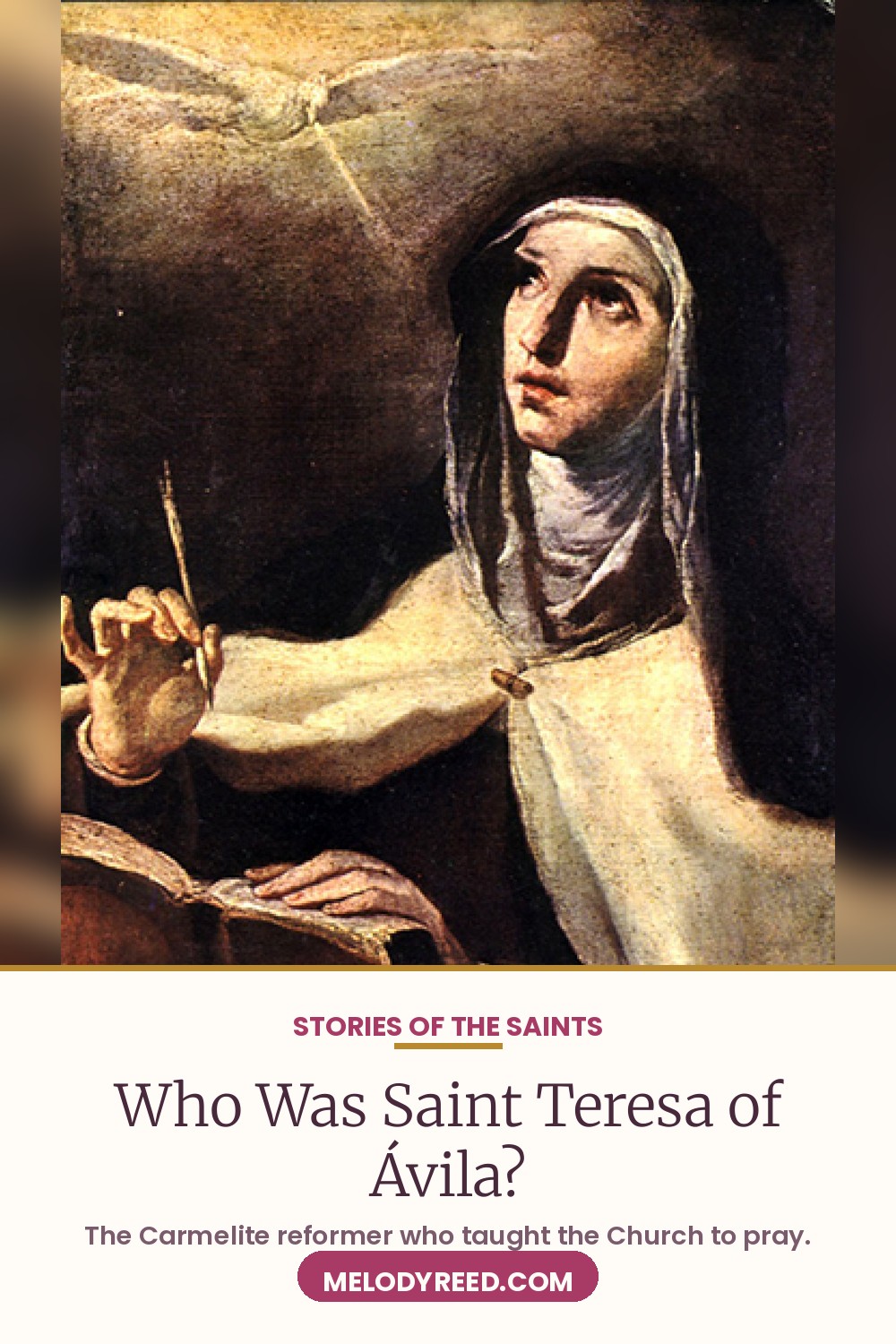
Stories of the Saints
Saint Teresa of Ávila
The Carmelite nun who rebuilt her order around prayer — and taught the Church how to find God within the soul.
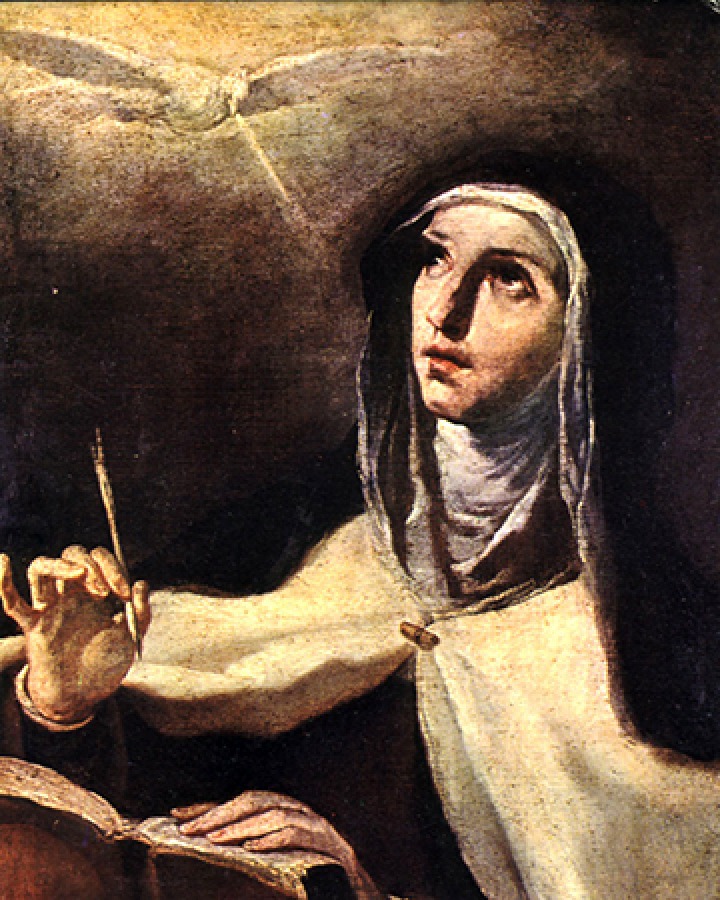
The Basics
- Feast day: October 15.
- Lived: March 28, 1515, to October 4, 1582.
- Born: Ávila, Spain.
- Religious name: Teresa of Jesus.
- Known for: Reforming the Carmelite Order, founding the Discalced Carmelites, and writing The Way of Perfection and The Interior Castle.
- Canonized: March 12, 1622, by Pope Gregory XV.
- Doctor of the Church: Declared by Pope Paul VI on September 27, 1970 — the first woman to receive that title.
A child with heaven on her mind
Teresa Sánchez de Cepeda y Ahumada was born in Ávila, Spain, on March 28, 1515. She grew up in a large, devout family and loved books, especially stories about the saints. She also loved the popular romances of knights and adventure that her mother enjoyed.
When Teresa was about seven, she persuaded her younger brother Rodrigo to run away with her. They intended to travel to Muslim-held lands and give their lives as martyrs. An uncle found them outside the city and brought them home.
The adventure was childish, but it revealed something that never left Teresa: she wanted her life to belong completely to God.
Her mother died while Teresa was still a girl. As she grew older, Teresa became more interested in clothes, novels, and the company of friends. Concerned about her, her father placed her with Augustinian nuns at Santa María de Gracia when she was sixteen.
Teresa disliked the school at first. Then the quieter life began to change her. She thought seriously about becoming a nun, but illness sent her home before she reached a decision.
A door she entered without permission
While recovering, Teresa read the letters of Saint Jerome and books given to her by an uncle. She became convinced that religious life was the path she should take. Her father refused to agree.
On November 2, 1535, twenty-year-old Teresa left home in secret and went to Ávila's Carmelite Monastery of the Incarnation. Her father eventually accepted what she had done. Teresa received the Carmelite habit, took the name Teresa of Jesus, and professed her vows in 1537.
Her new life was soon interrupted by severe illness. She left the monastery for treatment, grew worse, and spent nearly three years unable to walk. She later credited Saint Joseph with her recovery.
When Teresa returned to the Incarnation, she found a large community whose daily life had drifted far from the Carmelite rule's original simplicity. Visitors came and went, sisters often left the monastery, and conversation could fill the day. Teresa joined in much of that life. For years she wanted deeper prayer but kept turning away from it, afraid that she was not faithful enough to continue.
The turning point
In 1554, when Teresa was thirty-nine, she stood before an image of Christ badly wounded. Reading Saint Augustine's Confessions during the same period deepened the change. Teresa recognized herself in Augustine's divided heart, and she stopped holding part of her life back from God.
Her prayer became more focused and more intimate. She described mental prayer as time spent alone with the God who loves us. In her writings, she also described extraordinary experiences, including an angel piercing her heart with a golden dart. The experience became known as the transverberation.
Not everyone trusted what was happening. Some confessors feared that Teresa was being deceived. She answered by obeying them, telling them everything, and setting her experiences down in writing. That obedience gave the Church her spiritual autobiography, The Life of Teresa of Jesus.
A smaller house, a stricter rule
Teresa came to believe that Carmelite life needed to return to its roots: prayer, poverty, enclosure, and simplicity. In 1562 she founded Saint Joseph's Convent in Ávila, a small community of thirteen sisters who followed the original Carmelite rule more closely.
The new branch became known as the Discalced Carmelites. "Discalced" means unshod; the plain footwear and simple life were signs of the poverty Teresa wanted her communities to practice.
The reform brought trouble. Some people in Ávila opposed the new convent. Carmelite officials questioned Teresa's work, and she had to defend both her writings and her prayer. She kept going, combining prayer with practical skills. She dealt with property, money, travel, and difficult personalities, and she still made time to cook, clean, and work beside her sisters.
Over the next twenty years, Teresa founded seventeen convents for Carmelite nuns across Spain. In 1567 she met a young friar, John of the Cross, and persuaded him to help bring the same reform to Carmelite men. Their first friars' house opened at Duruelo in 1568.
In 1580, Pope Gregory XIII recognized Teresa's reformed communities as a separate province. The reform she had begun in one small Ávila convent now had a secure place within the Carmelite Order.
The teacher inside the castle
Teresa had no university education, and she wrote mainly because her confessors and sisters asked her to explain what she had learned. Yet her books became some of the most enduring guides to prayer in the Church.
In The Way of Perfection, she taught her sisters how to pray and how to live together with love, humility, and detachment. In The Interior Castle, she pictured the soul as a castle made of crystal or diamond, with many rooms. God dwells at the center. Prayer is the journey inward, room by room, toward the God who is already present.
That journey was never meant to end in private comfort. For Teresa, the closer a soul came to God, the more it was changed into someone who could love and serve other people.
Her final journey
Teresa founded her last convent at Burgos in 1582. On the journey back toward Ávila, her failing health forced her to stop at Alba de Tormes. She died there on October 4, 1582.
Spain adopted the Gregorian calendar that night. October 4 was followed by October 15, the date on which the Church keeps Teresa's feast.
Pope Gregory XV canonized Teresa on March 12, 1622. On September 27, 1970, Pope Paul VI declared her a Doctor of the Church, the first woman to receive that title.
Saint Teresa of Ávila, pray for us.