Why Catholics Do That
Why Do Catholics Pray the Rosary?
Beads for restless hands, a rhythm for a wandering mind, and the life of Jesus to rest your heart on.
The Short Answer
Catholics pray the Rosary to think about the life of Jesus with Mary beside them. The beads give the hands something steady to do, the repeated prayers give the mind a rhythm, and the mysteries — the stories of Christ's birth, life, death, and resurrection — give the heart something real to rest on. It is not a charm, and it is not worship of Mary. It is a way of praying the Gospel slowly.
The human moment
If you have ever sat in a hospital waiting room, you know what hands do when the mind is frightened. They look for something to hold. A cup. A sleeve. A phone. A string of beads.
That is part of the Rosary's kindness. Before it is anything else, it is prayer for people whose thoughts will not sit still.
Where it comes from
Christians have counted prayers for a very long time. In the early centuries, monks prayed all 150 psalms, and people who could not read or own a psalm book kept count of shorter prayers with pebbles, knots, or beads.
In time, those counted prayers took the shape many families still know by touch: 150 Hail Marys in place of the 150 psalms, sometimes called Mary's Psalter. The larger beads marked the Our Father, and the smaller beads carried the Hail Marys. In parts of Europe the beads themselves were called Paternosters, from the Latin words of the Lord's Prayer, Pater noster — "Our Father." The Rosary grew out of ordinary people's desire to pray with the same steady rhythm as the monks, using the prayers they could hold in memory.
Over the Middle Ages, the prayers that gathered around those beads became the ones we know: the Our Father, taught by Jesus himself, and the Hail Mary, built from the angel's greeting in Luke's Gospel — "Hail, full of grace, the Lord is with you" — and Elizabeth's cry, "Blessed are you among women." The second half of the Hail Mary, "Holy Mary, Mother of God, pray for us sinners," took shape later as the Church's own prayer asking Mary to intercede.
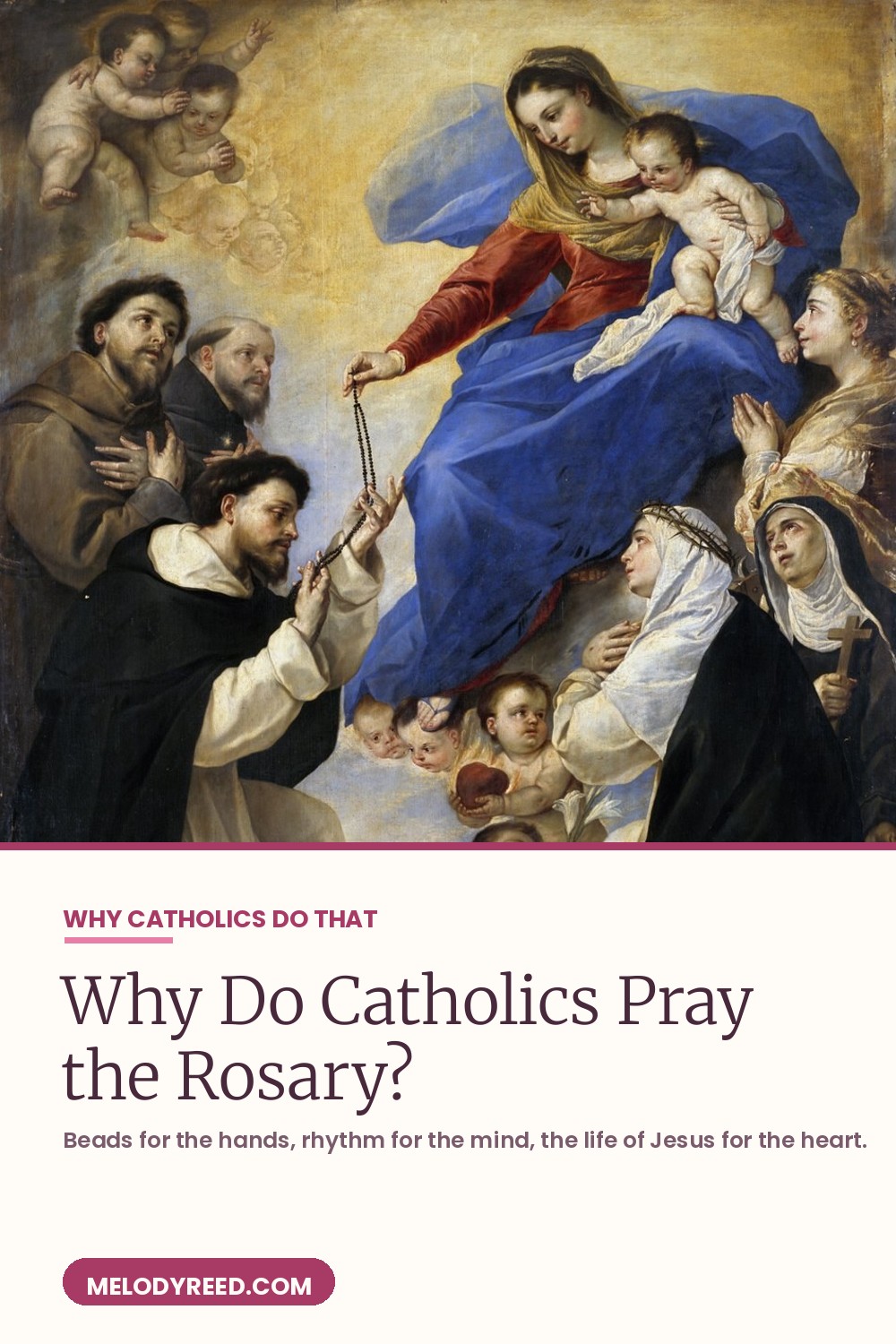
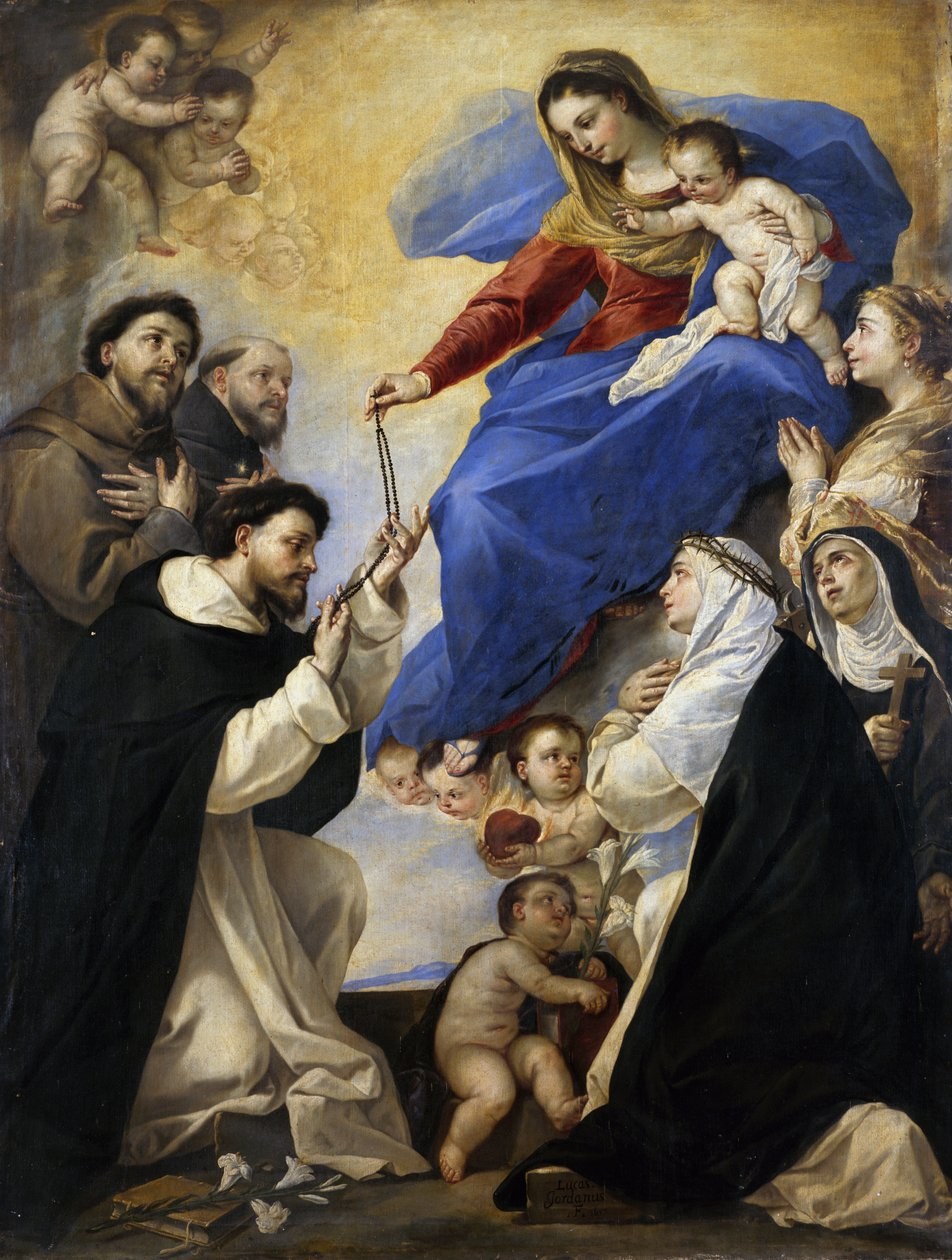
A beloved tradition says Saint Dominic received the Rosary from Our Lady in the thirteenth century. The documented history is slower and more ordinary: the devotion grew over centuries, through Dominicans, Carthusian monks, and many unnamed people who found that beads helped them pray. Pope Pius V gave the Rosary its standard form in 1569, Pope Leo XIII wrote about it so often that he is remembered as the Rosary Pope, and in 2002 Pope John Paul II added the Luminous Mysteries — moments from Jesus' public ministry, like his baptism and the wedding at Cana.
The stories prayed in the Rosary are called mysteries: the Joyful, Luminous, Sorrowful, and Glorious Mysteries. They are not mysteries in the sense of puzzles to solve. They are scenes to sit with.
What you actually pray
A full set of mysteries is five decades. Each decade begins with an Our Father, continues with ten Hail Marys while you think about one scene from the life of Jesus or Mary, and closes with the Glory Be. The Rosary usually begins with the Apostles' Creed and ends with prayers for the Church and the people you are carrying in your heart.
The Joyful Mysteries walk through the Annunciation, the Visitation, the birth of Jesus, his presentation in the Temple, and the finding of the child Jesus among the teachers. The Luminous Mysteries look at his baptism, the wedding at Cana, his preaching, the Transfiguration, and the Last Supper. The Sorrowful Mysteries stay with the Agony in the Garden, the scourging, the crowning with thorns, the carrying of the cross, and the crucifixion. The Glorious Mysteries begin with the Resurrection and move through the Ascension, Pentecost, Mary's Assumption, and her crowning in heaven.
Many Catholics follow a weekly rhythm: Joyful on Monday and Saturday, Luminous on Thursday, Sorrowful on Tuesday and Friday, and Glorious on Wednesday and Sunday. That rhythm is a helpful custom, not a rule. A person can pray any set of mysteries on any day, especially when one scene speaks to the need of the moment.
What Catholics actually believe
The Rosary is Christ-centered, even though Mary is named in every Hail Mary. The scenes being remembered are Jesus' scenes: his birth, his ministry, his cross, his resurrection. Mary appears the way she appears in the Gospels — close to her Son, pointing to him.
When Catholics ask Mary to "pray for us," they mean the same thing they mean when they ask a friend at church to pray for them. The Church teaches that those who have died in Christ are not lost to us; they are alive in him, and their love does not stop at the grave. We will take that up more fully in the next piece, "Why Do Catholics Pray to Saints?"
This is also why Catholics do not see the Rosary as choosing Mary instead of Jesus. The Rosary begins with the Creed — a confession of faith in God the Father, Son, and Holy Spirit — and every decade returns to scenes from Christ's life. Mary is honored because of who she is in that story: the mother of Jesus, the first disciple, the woman who said yes and stayed near the cross. In Catholic prayer, asking her intercession is meant to lead toward her Son, not away from him.
And the repetition? Jesus warned against babbling empty phrases as if God had to be worn down. Catholics take that warning seriously. The repeated Hail Marys are not the point of the prayer; they are the frame around the point. Like a rocking chair or a steady walking pace, the rhythm carries the attention back, again and again, to one scene from the life of Christ.
What it looks like in ordinary life
A set of mysteries takes about fifteen to twenty minutes. Some people pray all of it at a kitchen table before the house wakes. Some pray one decade — one mystery, ten Hail Marys — in the car. Some keep a rosary in a coat pocket and pray for the person in the ambulance passing by.
It also bends toward other people. A Rosary offered for a daughter waiting on test results. A decade on a lunch break for a friend in surgery. The beads have a way of giving love somewhere to go.
That is why you may hear the Rosary prayed at a wake, in a hospital room, or around a family table after hard news. In grief, people often cannot find many words of their own. The Rosary lends them words. It lets a room full of people breathe together, remember the life of Christ, and place the person they love into God's mercy one bead at a time.
Try it / pray it
You do not need beads to begin. Fingers count just as well.
Pick one mystery — say, the Annunciation, when the angel came to Mary and she said yes to something she did not fully understand. Pray one Our Father. Then ten Hail Marys, slowly, holding that scene in mind: a young woman, an impossible promise, a brave yes. Finish with the Glory Be.
If a whole set of mysteries feels like too much at first, begin with one decade. Five good minutes with one scene from the Gospel is better than waiting for a perfect quiet hour that may never come. Many people find that one decade becomes two, then five — not because they forced it, but because the prayer made room in the day.
If your mind wanders, do not scold it. Bring it back the way you would bring a child back to the table — kindly, and as many times as it takes. That returning is the prayer.
Let's pray. In the name of the Father, and of the Son, and of the Holy Spirit. Amen.
Hail Mary, full of grace, the Lord is with thee. Blessed art thou among women, and blessed is the fruit of thy womb, Jesus. Holy Mary, Mother of God, pray for us sinners, now and at the hour of our death. Amen.
May God bless you and yours.
Pray the Rosary with Melody, feast by feast and mystery by mystery, on the Prayers page — or walk the feasts on the Feasts & Holy Days calendar.