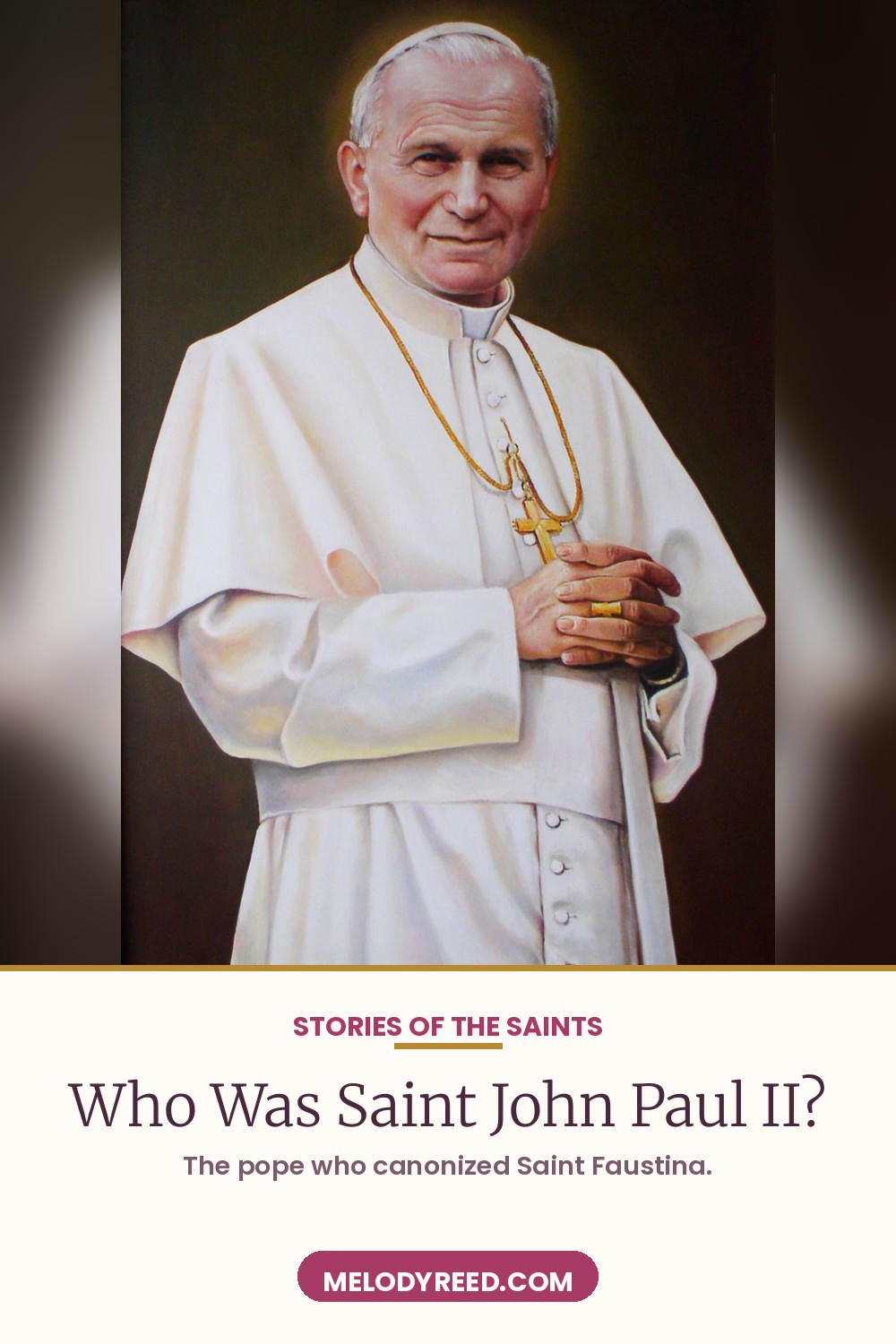
Stories of the Saints
Saint John Paul II
The pope from Poland who survived an assassin's bullet, forgave the man who shot him, and canonized Saint Faustina — the first saint of the new millennium.
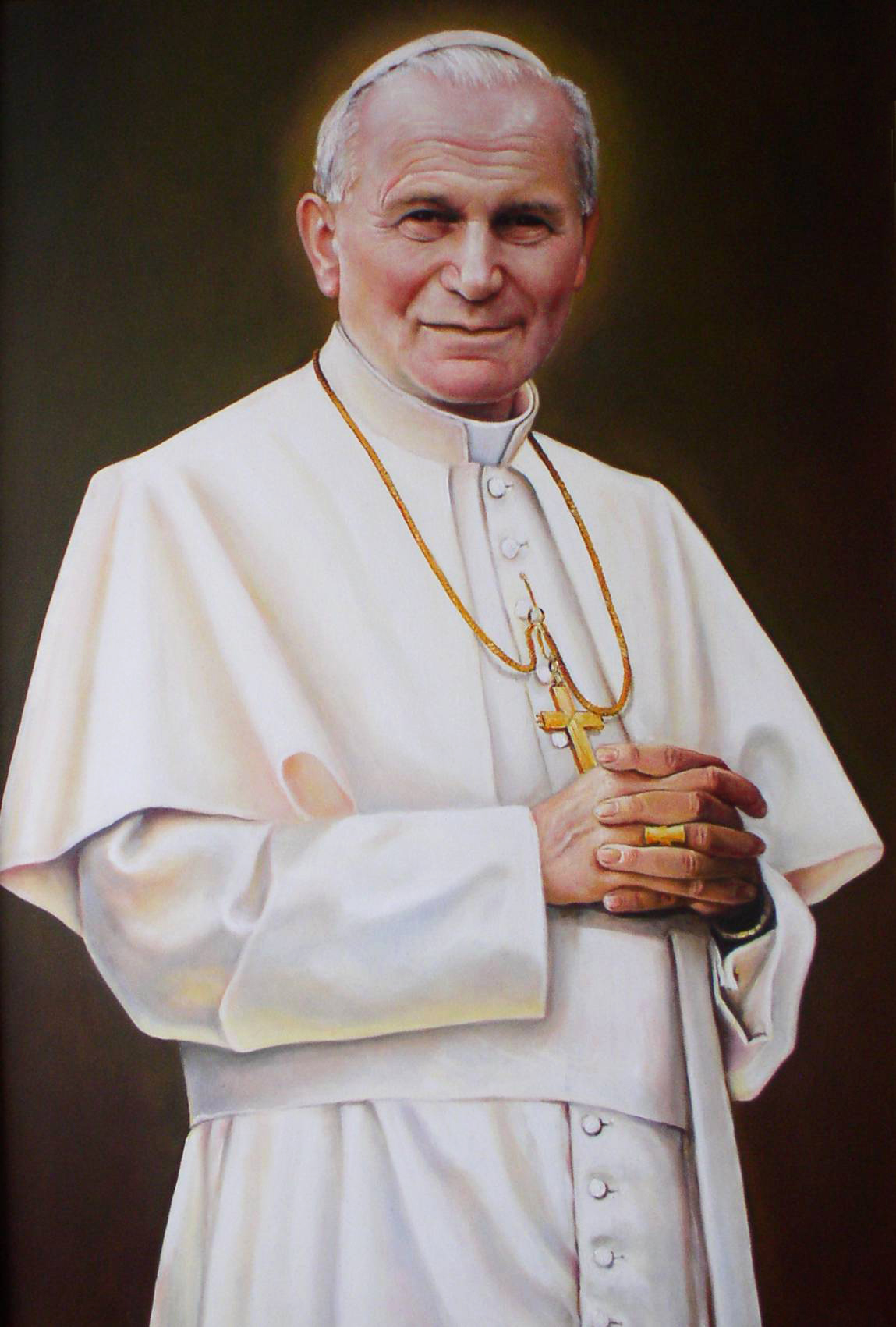
The Basics
- Feast day: October 22.
- Lived: May 18, 1920, to April 2, 2005.
- Born: Karol Józef Wojtyła, in Wadowice, Poland.
- Known for: Pope from 1978 to 2005, the first non-Italian pope in more than four centuries. He canonized Saint Faustina Kowalska and established Divine Mercy Sunday for the whole Church.
- Beatified: May 1, 2011, by Pope Benedict XVI.
- Canonized: April 27, 2014, by Pope Francis, together with Pope John XXIII.
- Motto: Totus Tuus — "totally yours," spoken to Mary.
A boy from Wadowice who lost almost everyone
Karol Józef Wojtyła was born on May 18, 1920, in Wadowice, a small town in southern Poland. His childhood was marked early by loss. His mother died while he was still a boy, and his brother died before he was grown. Then his father died too, and by the time Karol was a young man, the family he had been born into was gone.
Poland itself was in danger by then. Nazi Germany occupied the country, and the young Wojtyła worked in a quarry and in a chemical plant to get by. The work was hard and the occupation was brutal, and open religious life was driven underground.
Underneath that hard surface, another life was taking shape. While he worked in the quarry and the plant by day, Karol was studying for the priesthood in secret. The seminary training that would normally happen in classrooms and chapels happened quietly, hidden from the authorities. He had lost his family, his country was occupied, and still the call to the priesthood held.
Priest, bishop, cardinal
Karol Wojtyła was ordained a priest on November 1, 1946, after the war had ended. He served in Poland, in the region around Kraków, and rose steadily through the Church's responsibilities there. He became a bishop in 1958. In 1964 he became Archbishop of Kraków. In 1967 he was made a cardinal.
Each step put him closer to the life of the whole Church, but his roots stayed Polish and stayed near Kraków — the same part of Poland that Saint Faustina Kowalska had come from, a connection that would matter greatly later in his life.
The pope from Poland
On October 16, 1978, the College of Cardinals elected Cardinal Wojtyła pope. He took the name John Paul II. His pontificate began on October 22, 1978.
His election surprised the world. He was the first non-Italian pope since Adrian VI in the 1500s — the first pope in more than four centuries who did not come from Italy. A pope had come out of Poland, a country still living under Communist rule.
His motto as pope was Totus Tuus, Latin for "totally yours," words he addressed to Mary, the mother of Jesus. He would lead the Church for more than twenty-six years, one of the longest pontificates in history, traveling, teaching, and writing through all of it.
The shot in Saint Peter's Square
On May 13, 1981, John Paul II was riding through Saint Peter's Square when a gunman shot him. May 13 is the feast of Our Lady of Fátima. The pope was badly wounded, but he survived.
What he did afterward is the part of the story the Church remembers most. He forgave the man who had shot him. The forgiveness was public and complete — the pope who had nearly been killed held no sentence over the man who tried to kill him. The attempt on his life became, in his own handling of it, a lesson in the mercy he spent his pontificate teaching.
The pope who canonized Faustina
On April 30, 2000, John Paul II canonized Saint Faustina Kowalska, the Polish nun from the Kraków area who had received the message of Divine Mercy. Faustina became the first saint canonized in the new millennium.
At that same celebration, he established Divine Mercy Sunday for the universal Church, fixing the feast Faustina's writings had asked for onto the calendar of the whole Church. The connection ran deep: a Polish pope, formed in the same region and the same hard century as Faustina, carried her message to the entire world.
He died on the vigil of Divine Mercy Sunday
John Paul II died on April 2, 2005, at the Vatican, aged 84. The date carried its own meaning. April 2, 2005, was the vigil of Divine Mercy Sunday — the feast he himself had established five years earlier, on the day he canonized Faustina.
The pattern held through everything that followed. Pope Benedict XVI beatified him on May 1, 2011 — Divine Mercy Sunday. Pope Francis canonized him on April 27, 2014 — also Divine Mercy Sunday — together with Pope John XXIII.
His feast day is October 22. It is not the date of his death. October 22 is the anniversary of the day his pontificate began in 1978, the day the pope from Poland first stepped into the office he would hold for more than a quarter of a century.
Saint John Paul II, pray for us.